Paperwork your compliance team will sign off on.
TSCA Title VI and CARB Phase 2 certification for unfaced plywood, FSC Mix panels on request, Lacey Act species data and Georgian origin.
Compliance, point by point.
TSCA Title VI & CARB Phase 2 certified
Certified by EPH Dresden (TPC-10): certificate TSCA-CARB-2023-03-22-04, attestation TSCA-CARB-2026-04-28-01 (April 28, 2026), exterior PF plywood, unfaced, 6–30 mm, with quarterly third-party testing. Also a ULEF exemption, TPC-10/ULEF-E/2122134-PW-2026-01, valid through April 27, 2028. EN 717-1 chamber test (EPH Dresden, 24 mm): 0.011 mg/m³ formaldehyde, about one sixth of the EU REACH limit; report on request.
FSC chain of custody
Palati 2022 LLC holds FSC chain-of-custody certificate SGSCH-COC-230134, issued by SGS and valid through August 24, 2031; verify it on search.fsc.org. FSC-certified panels are available on request, and for certified orders the FSC claim appears on the commercial invoice, packing list and bill of lading.
Lacey Act
Export documents declare the species, Betula pendula / Betula pubescens (silver and downy birch), for your Lacey Act declaration (PPQ Form 505). Country of harvest: Latvia. Veneer supplier: Estonia. Ask us for the supplier documents your broker needs for due care.
Country of origin: Republic of Georgia
Every panel is manufactured at Palati’s Rustavi plant — veneer grading, gluing with phenol-formaldehyde resin, cold and hot pressing, sanding and trimming. Palati holds Authorized Exporter status with Georgian customs, and shipments qualify for a Georgian certificate of origin, issued on request.
Raw material
Birch harvested in Latvia, bought as pre-peeled, rotary-cut veneer from an Estonian supplier — not logs, and not Georgian timber. Every ply is birch. Sample incoming-veneer documents are available for compliance review.
Batch traceability
Each bundle carries a barcode label with its batch information, so a delivery can be traced back to its production run.
CE factory production control
Certificate of Conformity of the Factory Production Control 0766-CPR-642/1 (EN 13986), issued by EPH Dresden. Formaldehyde class E1 is declared in the manufacturer’s Declaration of Performance (unfaced and film-faced); unfaced panels tested to EN 717-1 by EPH Dresden: 0.011 mg/m³.
Company details
Palati 2022 LLC: registered office in Tbilisi; manufacturing plant at 4 Mazniashvili St., Rustavi 3700, Republic of Georgia.
What ships with your order.
Need something specific for your buyer or auditor? Ask before you order — we’ll confirm it in your quote.
- Commercial invoice
- Packing list with batch information
- Bill of lading
- TSCA Title VI / CARB certificate and ULEF exemption
- FSC claim on documents and certificate (certified orders)
- Species declaration for your Lacey Act filing
- Georgian certificate of origin (on request)
- CE factory production control certificate
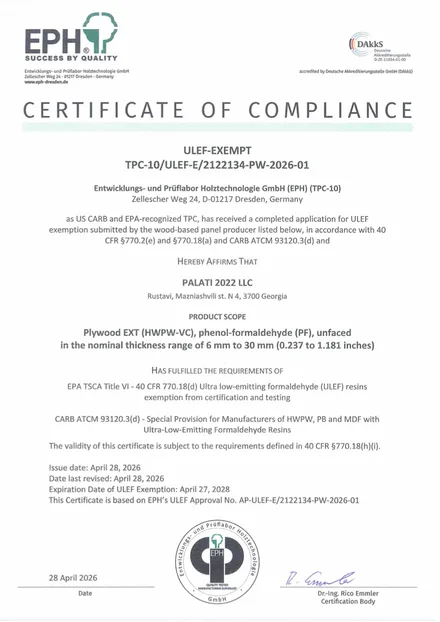
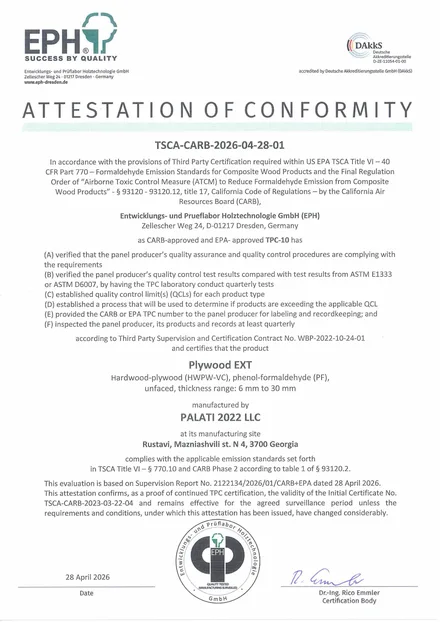
View and download certificates
Compliance questions.
Where is the plywood made?
Every panel goes through the full manufacturing cycle at Palati’s plant in Rustavi, Republic of Georgia: veneer grading, gluing, cold and hot pressing, sanding and trimming. Palati is an Authorized Exporter, and shipments qualify for a Georgian certificate of origin, issued on request. AllBirch, led by Stefan Popov, distributes Palati products in the United States.
Is the plywood TSCA Title VI and CARB compliant?
Yes. Palati’s unfaced phenol-formaldehyde plywood, 6–30 mm, is certified to the EPA TSCA Title VI and CARB Phase 2 emission standards by EPH Dresden, an EPA- and CARB-recognized third-party certifier (TPC-10): certificate TSCA-CARB-2023-03-22-04, confirmed by attestation TSCA-CARB-2026-04-28-01 after quarterly testing. The mill also holds a ULEF exemption (certificate TPC-10/ULEF-E/2122134-PW-2026-01, valid through April 27, 2028). In an EN 717-1 chamber test by EPH Dresden (24 mm, unfaced), formaldehyde release measured 0.011 mg/m³, about one sixth of the EU REACH limit of 0.062 mg/m³; the test report is available on request. Download the certificates on our Certificates page. For film-faced panels, ask us for the formaldehyde documents that apply to your order.
Where does the wood come from?
The birch (Betula pendula / Betula pubescens) is harvested in Latvia, in the EU. The mill buys it as pre-peeled, rotary-cut veneer from a supplier in Estonia — not logs, and not Georgian timber — and every ply in the panel is birch. The species and country of harvest are available for your Lacey Act declaration, and every bundle carries a barcode label with its batch information. For FSC orders, Palati’s chain-of-custody certificate (SGSCH-COC-230134, issued by SGS) can be verified on search.fsc.org.
Is FSC-certified plywood available?
Yes. FSC Mix certified panels are available on request under Palati 2022 LLC’s chain-of-custody certificate (SGSCH-COC-230134, issued by SGS). For certified orders, the FSC claim appears on the commercial invoice, packing list and bill of lading. Let us know if you need FSC when you request a quote.
What import duties apply?
Birch plywood typically classifies under HTS 4412.33.06 (general rate: free) and film-faced panels under 4412.33.57 (8%). Any additional tariffs in effect on the entry date also apply. The 2026 antidumping and countervailing duty cases on hardwood plywood cover China, Indonesia and Vietnam, not the Republic of Georgia. Final classification is the importer’s responsibility, so confirm with your customs broker; we confirm the current picture in your quote.
Can I use it for subfloor or structural sheathing?
No. Palati birch plywood is declared EN 636-3 S (6–30 mm) under its CE Declaration of Performance, an EU exterior-use class, but they are not PS 1 / PS 2 rated or APA-trademarked, so they are not sold for code-required structural sheathing, subflooring or roof decking in the U.S. They’re industrial and appearance-grade plywood for furniture, cabinetry, fixtures, flooring cores, formwork, transport and packaging.